
 We recently visited Kenya during the week when the Good Neighbours Ministries team did the annual re-enrolment interviews with the children Grassroots supports. It was great to be with them and have the opportunity to the assess how things are going.
On the edge. That’s the best way to describe Theta. On the edge of Nairobi. On the edge of civilisation. On the edge of being able to get by. For the families in this community, just one more problem, even a small one, knocks them over that edge.
Driving from our accommodation to Theta starts along the new “super highway” going North out of Nairobi. We then take an exit and are very soon surrounded by little minibuses, pulling in to pick up the many people waiting for a ride. Beyond the junction we start on a tarmac road, but it very soon becomes rough. We take a left, a right, a left again. Crowds of people walk on both sides of the road, and sometimes down the middle. George slows the car to gently cross the lines of the railway. The rails are not protected in any way and other cars have turned on to the line and are using it as a shortcut. Beyond the “unlevel crossing” we drive on a couple of kilometres and eventually the tarmac ends completely and the road ahead is now made of large rocks embedded in soil, going about 100ms across a valley. In the rainy season this can be a raging river, but right now is just mud covered in vegetation that grows high on each side of the “bridge”. The car needs to move very slowly as the suspension struggles over each rock and there are cars and trucks coming the other way, tipping each time they go over a rock. This type of road continues up the other side of the valley where it becomes a narrow lane that leads up to Theta’s “high street”. This is lined either side with lock up shops, meat stalls, little offices, bars, workshops and street vending booths. There’s a strong smell of charcoal burning, the sound of electric tools coming from a carpentry stall and flashes of bright light coming from someone welding bits of metal. The heart of the community!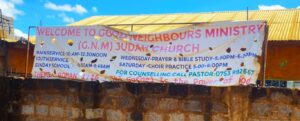
Once down the high street the road becomes mud, passing between basic houses and bits of waste ground. We turn right, then left, past a site where they are building a house …. and there it is. Good Neighbours church building!
It isn’t impressive. Just another small building with a tattered sign on the wall with the times of services and other meetings.
 We park round the back and then walk through the iron gates into the small yard. Families are beginning to gather for the sponsorship annual interviews. There are tables set up, and lists of those who will be interviewed today, and Kezia (George & Grace’s daughter, who has just completed a performing arts degree) has been working with the children to prepare a welcome presentation for their visitors. That’s us!
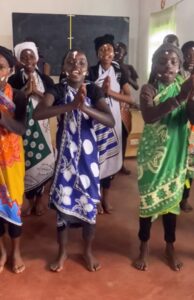
The children’s presentation includes drama sketches, thank you songs and a Kikuyu Blessing dance (picture on right). Over and over, they expressed thankfulness to God and to all the Grassroots sponsors for the massive difference you have made.
The Interviewing Team!
The Good Neighbours team who will be conducting the interviews are Kezia, Moses, Leah, David and Pastor George & his wife, Grace. Sharon also gets involved with each interview, welcoming each family at the beginning and praying with them at the end. Apart from George, Grace and Sharon, all the others on the team are young people from the church.
 Leah has been sponsored since she was small until she completed form 4 (the equivalent of GCSEs) at secondary school last year. She wants to do a course on “Beauty” and is working out how to apply and how much it will cost. She did a brilliant job interviewing. She chatted in Swahili to the children and parents and wrote the answers on the Grassroots form in English, in beautiful clear handwriting!
Moses is a bit older. He completed form 4 two years ago. He has worked out what he wants to do next, which is to go to university for which he has been offered a 50% scholarship. He and his family are fundraising (having special events with neighbours and friends) to try and get together the rest of the money he needs before being able to register. During the interviews he showed great maturity and natural authority.
 David had a different role. He is member of the church who is so committed to the sponsorship programme that he turns up every time the children gather for catch up lessons. This happens 3 times each week, with different age groups each time. The lessons are streamed from the internet onto a big screen in the church. Good Neighbours has registered to be a hub for these courses that fit with the Kenya curriculum. During each session (and again on Sunday) porridge is served in mugs to both the children at the lessons and any others that turn up because they are hungry. This makes sure the children have some food in their tummies, as it cannot be guaranteed at home.
David is not in charge of the technology that streams the catch-up lessons (Grassroots funds someone else to do that) but he comes along and knows each of the children and their parents. If any issues come up that need extra help, David gets told and he lets George know.
David was with the team throughout the week of interviews, making sure that the right children were there at the right time and contacting the family of any child who was not there when expected. He has another job! He is a self-employed plumber. This gives him work on and off and he earns when he gets jobs. Over the last year he has been such a key player that we have agreed with George to employ him four half days a week as “Carer and Children’s Coordinator” for the sponsorship and emergency food programmes.
Over the Edge
Each interview includes quite a few questions about how the family is doing, and a parent or guardian has to be present to sign, giving permission for Grassroots to share the child’s photograph and information with their child’s sponsor.
After the interview, Grace measures and records the child’s height and weight. We then take the child’s photo. The child is then given an opportunity to draw a picture or write a letter for their sponsor.

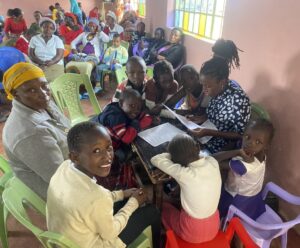

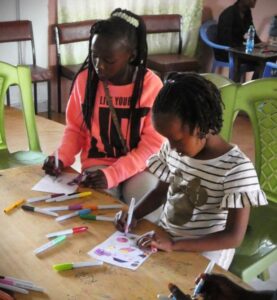
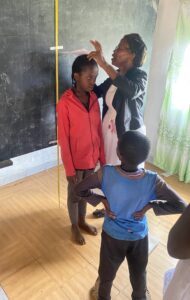
During this process there are many opportunities for the team to find out how the family is doing, whether the children are about the right BMI (height and weight for their age) and to notice any things that need some kind of intervention. This year this was very important for a number of the families in Theta. After a few questions it became clear that new problems have knocked them over the edge into new crises.
One family had been stable until the husband, who had a relatively consistent job as a motorbike taxi driver, became mentally ill and had to go to hospital. While there, he got out of bed in a kind of trance and tried to leave. He walked through what he thought was a door, but it was actually a 4th floor window. He fell and, although he survived, he broke both arms and both legs. So, now the family has no income and large hospital bills. The mother is at home, desperate, trying to feed the children. The team had known none of this because the mother was so ashamed she was not telling anyone. The interview process allowed the team to ask her if she was ok. She instantly broke and told the whole story. As a result, we have been able to provide extra food parcels and George and the church have been able to start giving the support the family so desperately needs.
This was just one of a number of situations where an extra intervention was needed.
Post Form 4
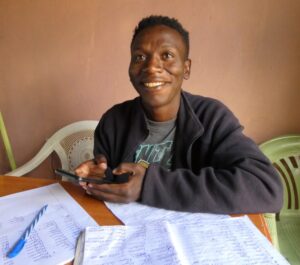 David has another role in helping those who lead the young adults group in Good Neighbours Ministries.
One of David’s great concerns has been the young people who have just finished form 4 – the fourth year of secondary school. Previously, Grassroots child sponsorship officially stopped at the end of Form 4, which is the last year of secondary education. We understood that completing secondary education and getting a KCSE grade was enough to help most young people move forward in life.
Before we arrived, David organised the previously sponsored young people who had completed form 4 in 2021 and 2022 to put together a presentation for the visiting Grassroots team. Their main point was asking that Grassroots sponsorship might continue, to help them get some education, training or apprenticeship that would help them get a proper job.
All post form 4 education, whether at university or at vocational training college, needs money! Young people who have grown up in Theta, don’t have that kind of money. As a result, most of them leave school and have no way of moving forward. They get stuck!
It was an interesting meeting, and we thought they had a point. We asked them to come back with more details of the options, costs and some proposals. When we met again, this was their outline of the options available:
• University: At the end of Form 4 each young person receives a KCSE grade. A is the best. C+ and above, can apply for university (Yes. University straight after form 4. Some are still 16, but many older.). With these high grades a young person can apply to university through the “government portal”, which means that they can either ask for a government loan or forgo the loan and get a subsidised price.
• Vocational Training: Those who get a grade of C, C- or D can apply to go to a vocational training college. The upside is that these colleges provide training towards formal, recognised qualifications in various trades. The difficulty is that the courses are very expensive, and there are no government loans available. If travel and accommodation are needed, it makes it almost impossible for a young person from a poor background!
• Apprenticeship: Instead of a formal (expensive!) education or training course, the young person could decide to become an apprentice to someone who is a tradesperson or shopkeeper. This has no official standing in the Kenyan education system, but George tells us many local people working as beauticians, plumbers, carpenters, mechanics, bakers, shopkeepers, etc would be willing to include a young person as an apprentice. The young person could learn enough on the job and through the internet to be able to register to take exams and become qualified in that trade. It was suggested that the person taking on an apprentice could be offered a small grant for providing the opportunity and the training.
In this context, we explained that Grassroots sponsorship in Kenya only provides £60 per year per child. The young people explained that this amount (or just a little bit more) could make all the difference to them being given an apprenticeship opportunity, and if they also explored other ways of raising funds/getting scholarships, it could even give them just enough to get them on to other courses. Each situation would be different but even about £100 per year could bridge the gap to making their future dream possible!
So … we agreed a way forward!
Each sponsored young person who has recently finished form 4 can now apply to have their sponsorship continue by submitting a form telling us what they hope to do, with details of the costs involved and saying how much money they can raise from family or doing casual work. Each of these applications will be considered on its merits, and if it makes sense the young person’s sponsorship will continue.
If you have been sponsoring one of these young people, you will receive a certificate as usual which will explain what is happening and how your sponsorship money is being spent. Grassroots will probably need to give the young person a little more than the usual sponsorship money in order to make the difference needed. If you wish to contribute to this extra cost, then that would be smashing! 😊

Emergency Food for Very Hungry Children
In recent months we have become increasingly concerned about children not eating regularly. During this trip to Kenya we came across a number of families whose cupboards were bare. We were able to give each one an emergency food parcel.
Lack of food causes children to present with stomach ulcers or anaemia, but the underlying reason is lack of food security. Children need to eat regularly and so this situation requires immediate action.
 Sponsorship pays for every sponsored child to have porridge 3 times per week and each sponsored primary school child to have a full meal every Saturday, but many other hungry children also turn up and the extra cost is considerable.
If you would like to help, it is possible to give specifically to the “Emergency Food for Very Hungry Children” fund. (https://grassroots.org.uk/product/emergency-food-for-very-hungry-children/) . This money is used to pay for the regular porridge programme and emergency food parcels for families identified as at risk. 100% of money given here will be passed on to the team in Kenya to fill empty tummies. This will really put smiles on faces. Thank you!
Join the team helping with the annual sponsored child interviews – April 2024
We expect to take a team of volunteers with us in 2024 to conduct the re-enrolment interviews with the sponsored children (and their families) and take the photos. The plan is to spend a week in Kenya, both in the Theta community and also visiting Watu wa Maana Street Children’s centre. The dates are dependent on the dates of school holidays in Kenya, which we will know in a few months’ time. If you are interested in being part of the team, then please get in touch and let me know. We will then keep you in the loop and as soon as things are certain we will send you the application forms and details of what you will have to do to be ready for the trip – including an orientation meeting (which might be in our house in Farnham or online via zoom), things to take, visa process, vaccinations, costs, flights, etc.
Thank you for all you are going…. and praying!
Without your partnership it would be impossible to help the lovely children and families in the Theta community. What you do and give achieves so much in their lives! A little truly goes a long way! We are so grateful for your trust, generosity and prayers.
