

We recently visited Kenya and spent a couple of days in the centre meeting the children and finding out from the team how things have been going.
A bit of background….
The Kenyan government has a children’s services department in most districts. They are responsible for intervening when a child is neglected, but there are so many families living in desperate situations that children’s services staff are under enormous pressure and there are not enough government places to accommodate the number of children needing help. This usually means that the police have been called by someone in the community to tell them a young child’s parents have abandoned them and they are living alone or wandering the streets begging for food. In these cases, the children’s services team turn up with the police, pick up the children and drive away. It’s at this point that the government social workers know they have a dilemma. They know the children need a safe place to live, but there are very few government funded children’s homes.
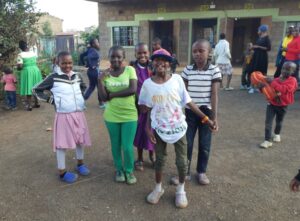 In the early days of Watu wa Maana, almost all the children who came to live in the centre had previously been living on the street. Recently the new residents have almost all been “referred” by one of the local districts’ children’s services teams. Wanjiru and John (Wanjiru’s husband – who has recently retired from his job as a university administrator) now lead the Watu wa Maana team. John described to us how a referral by children’s services happens.
A car turns into the Watu wa Maana property. In the back are one or more children. The driver gets out and walks over to the team members who they can see, introduces themselves as a children’s services social worker and says, “I wonder if you can help us. These children have been badly neglected and we don’t have anyone who can look after them. Is there any way you could have them for a couple of days. We will be back next week once we have found a more permanent solution.”
The Watu wa Maana team ask a few questions and complete the necessary forms but, obviously, try to take the children into their care. Eventually the children stay at Watu wa Maana and the car drives away. John tells us, “We know they won’t be back. They know they won’t be back. It’s the way it is!”
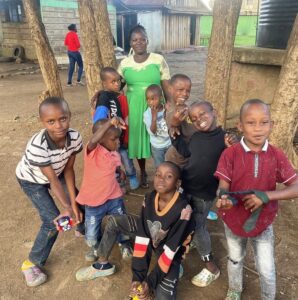 This process has happened a number of times over the last few months. It means that there are now 10 boys between the ages of 4 and 8 years old who are full time residents in the centre. Children of this age need more engaged care than older children, so Wanjiru and John decided that they had to employ another member of staff to be housemother for this group of boys. Esther (in the picture on the right) is great to have on team, and the boys love her!
A Safe Place…
The initial job is to provide a safe place to be a home for the children, providing them with a roof over their head, food in their tummies and people to organise them so they are wearing decent clean clothes and are consistently attending school. Once that is happening the Watu wa Maana social workers start their work, trying to find out information regarding the family of each child. Sadly, the only name many of the children know for their parent is “Mummy”. The police have usually provided little more information. Sometimes all the team start with is the place where the child was found wandering. Date of birth is guessed at. Place of birth, the same. And then there is the trauma that the child has experienced. Often the facts are sketchy, while the present behaviour slowly becomes more extreme. At first a young child might play happily with their new friends, sometimes appearing extra helpful. But, after a while, they feel safer and begin to allow themselves to express some of the pain they are feeling deep inside. The truth is they have a footprint of damage on their soul. The long process of rehabilitation begins. The team have walked this path before.
They know the hurt and rejection will come to bite as the child grows and they understand they were abandoned. The task is to pour in love and acceptance, in the context of safe boundaries and clear expectations. Putting feelings of self-worth and value into a child’s spirit takes time.
One of the reasons Wanjuru decided to call the centre Watu Wa Manna was to speak value over the children. It means “Children of the King”, which the term sometimes used in Swahili for VIPs, “very important people”. Although the children arrive with sad stories, this is a place of hope!
Brilliant Staff team
At the moment the Watu wa Maana staff team is as follows:
• Wanjiru – is the director. She is responsible to the board for the day to day running of the centre.
 • John (Wanjiru’s husband) – is also at the centre every day and is supporting Wanjiru while acting as the temporary “housefather & pastor”. Until last year Pastor James was taking this role. He has now moved on and so Wanjiru and John are actively looking to recruit his replacement while doing the work themselves.
• Janet – is responsible for the garden where they grow vegetables that are a key part of the children’s diet. When the cooking is happening Janet makes sure the vegetable that are in season are picked and ready to be cleaned, chopped and added. Janet has a number of children helping her tend and water the plants. The children rotate jobs/chores so each child gets the opportunity to learn from Janet.
• Alicett – is responsible for the cooking. Again the children join in and Alicett teaches and works with them until amazing nutritious food is ready on every child’s plate. She lives on site and also acts as housemother at times.
• Esther – is housemother for the younger children. At the moment, that is the 10 boys we mentioned above.
• 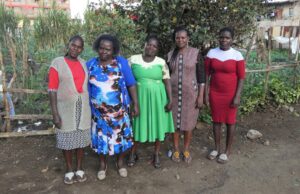 Charity – is the junior social worker. Charity has been on the staff at Watu wa Maana for a number of years. Charity is now married to James and they have a young family. Their children have some complex issues and so they no longer live on site. In this context, Wanjiru and the board have decided they needed to increase the social worker team and so have recently recruited a much more qualified social worker who is….
• Stacey – is now the senior social worker. She started in April 2023 and is in the process of working with Charity to understand the system and beginning to both improve it and getting the administration from paper onto the computer. Stacey is living onsite and is a great addition to the team!
The Social Workers’ main goal – Reintegration!
While all the team are working with the children to heal and rehabilitate them, the social workers’ main responsibility is to put in place everything needed to enable the children to leave the centre and restart normal life in the community, living as a member of a family. Good practice is to always start by finding out where the child came from, who their parents and extended family are and whether there is a safe way for the child to start exploring going to live with a close relative and be supported in a careful transition to that becoming a permanent long-term solution to their need for family, love, nutrition, education, development and future opportunity. If a part of the child’s extended family cannot be found that fits these criteria, the next option is to find a foster family who would be happy to work with Watu wa Maana, welcome the child and include them in their family.
The first part of this process is research, getting all the child’s paperwork in order and going to visit any of the child’s close relatives that are willing to be met. This takes quite a bit of time, phone calls and some travel, and sometimes still leaves the team confused as to the best way forward. If a parent cannot be found or is unwilling to be helpful, the team also have to do legal work to establish official guardianship of the child.

All this usually takes months, but the hope is to identify a person or family who is willing to explore building a new relationship with the child. Nothing is done in haste. Conversations are had and suggestions are discussed and agreed to by both the child and the potential host or carer. Many times the process starts with either the carer coming to visit the child at the centre and/or the child going with the social worker to visit the carer at their home. Then the idea of a longer visit may be raised, possibly staying for a few days over the Christmas holidays. If this is agreed the social worker has to visit the home again to check the physical structure of the home is well enough maintained and the child can stay there safely – which may include things like making sure the child can have a separate place to sleep and there is a lock on the toilet door. There also has to be research done into other people and relatives who may visit the house and whether it is safe for the child to be in contact with them. All complex, painstaking stuff!
This all may seem like hard work. Why not just let the child grow up at Watu wa Maana? But it is always better to grow up in a loving safe family home, than in an institution. For some children it has proved hard to find good a plan and they like in Watu wa Maana, but that is the last resort.
Education, Sponsorship and Costs
Every child in Watu wa Maana is enrolled in a local school. Most need to have some kind of fees paid or some payment that amounts to the same as fees. Children of different ages have different needs for uniform, shoes, school bag and other school kit. For each child the annual sponsorship money is used to cover the most important things for them. It also gets spent on the child’s bedding, clothes washing, electricity, food and the staff needed to run the centre. Full board is not cheap even in Kenya. Even with all the sponsorship money things come up that are not expected, like medical bills. The Watu wa Maana team’s approach is to consider every child as part of the family and provide them with what they need, and trust that God will prompt people to help them enough so that all the bills are covered.

Joining a Team of Grassroots Volunteers going to Kenya in 2023
Once a year Grassroots has an opportunity to take a team of volunteers to visit the children in Watu wa Maana and our other partner project, with Good Neighbours Church in Theta. We meet, photograph and interview all the sponsored children in both projects. We spend at least one day with everyone at Watu wa Maana. We would love you to join us. Exact dates are still being discussed so please let us know if you are interested in being part of the team next year. I will then contact you with the dates as soon as we have them and send you the application forms, details of costs, orientation events, flights and what has to be done to be ready for the trip.
Thank you again. Every little prayer goes a long way. Every gift – small or big – goes a long way.