Reflections on the many changes to Watu wa Maana’s ways of working during 2020
In March, the COVID19 pandemic took a grip in Europe and there was great concern about what would happen when it spread to Africa. The Kenyan government, like most others on the continent, closed all schools and immediately introduced many other restrictions. With hindsight this was probably too early as the wave of infections probably arrived in the country quite a few months later, and by that time lockdown had already gone on too long and people had to get out an about. Nobody really knows what has happened in Kenya because most of the poor who became sick never went for a test – not a great surprise as at the beginning there were high costs if your tested positive, and later on they were charging about £50 to have a test. What we do know is that there was great fear in the communities around Ruiru and many people became sick.
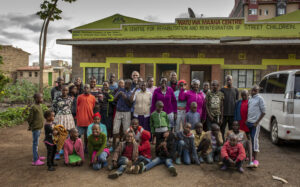
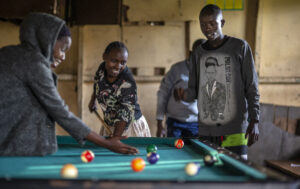
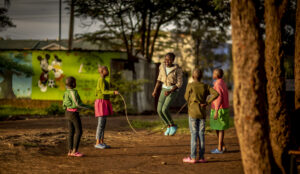

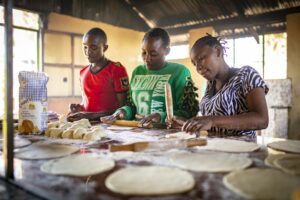
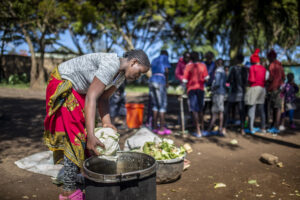
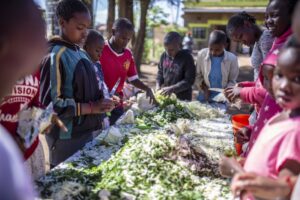
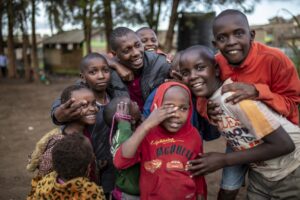
The Kenyan approach to children’s centres like Watu wa Maana was immediately to demand that all residents go and stay with someone in their extended family. The fear was that COVID19 would get a hold in these institutions and so a way to stop that was to empty them. Of course, that was easier commanded than done. The whole reason for most of the children being at Watu wa Maana was because their home family life had broken down or was abusive. Finding a safe family home for each child was a mammoth task. For some of the children it was impossible and so the Watu wa Maana staff made a decision to keep those children at the centre.
Closing the schools was also possibly an over-reaction. Very quickly the government announced that schools would remain closed until January 2021 (the beginning of the next school year. They then said that every child would have the start the “standard” they were in (year of education) again in January. Schools were also ordered to pay parents back their entire school fees, something which all schools found hard to do as they still had set costs and had already started paying teachers and other staff for the year. By the time September started this policy was changed so that from October some of the standards/year groups that were meant to be taking important exams in 2020 were told to return to school and expect to have a half year of education and take exams in the late Spring – which was even harder for schools because they now had to open but could only have a small proportion of the pupils (and small proportion of the money), and those year groups are now out of sync with the standards that will restart in January. All very confused.
 In the meantime, there was a massive economic impact, particularly on daily workers and others who had to leave their homes and mix with others in order to just have enough to feed their family. It was not a good time to send estranged children and teenagers to live with adults who were already struggling with life. But it was the law, so the team set about doing their best.
Some of the children were placed in homes in the Ruiru community. This meant it was quite easy for the team to visit, check on them and for the children to come back to the centre to get help or join in. Many of these children came back every Sunday for the worship service that is run on site. This was not possible for the first few weeks but quite soon social distancing rules for that kind of gathering were in place – as it was never going to be possible for the majority of the poor to access this kind of event online. Watu wa Maana welcomed these children on a Sunday and made sure they got food.
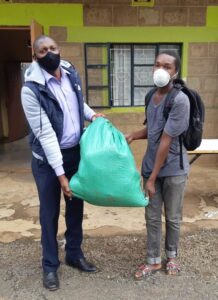
Watu wa Maana also decided to provide a regular pack of food and other essentials for each child living outside the centre to come and collect and take back to the place they were staying. This was a massive undertaking with the children coming to the centre and then moving down a line of tables being given all sorts of stuff. There is a video of one of these occasions posted on the Grassroots website blog here: https://grassroots.org.uk/watuwa-maana-street-kids-being-supported-in-the-community/
This level of support has proved harder to give to the children who had been placed into homes that were further away. Initially they were organised and funded to return every few weeks and receive a parcel of food and take it back to where they are staying. Where that has proved difficult other solutions have been found to make sure that have food, hygiene materials and a safe place to live.
At the moment the Watu wa Maana team is doing a full assessment of each child’s situation. They are checking that they have food, safety, emotional support, appropriate clothes, a place to sleep that is dry and secure, and the best way for them to access education when it reopens. Some children have received home visits from the team. In some cases, it is clear that their home conditions could be improved with a small amount of financial intervention. Building an extra room so there is more space in the house removes one of the main reasons for young people being told to move out. Even adding a wall in a house so a child can have their own bedroom can make a big difference to how a young person feels. Some of the houses are very rough and repairs to the roof or an improved floor is what is needed. For those trying to do schoolwork, a desk and chair, with a solar powered work light makes a massive difference. Supplying mattresses and new mosquito nets are basic essentials for every home which doesn’t have them.
For many of the children the only way for them to start going to school again is to return to live at Watu wa Maana. Although some of the children may be able to go to a school closer to where they have been living, they need to get back into the system in the school they have been attending and then apply for a transfer.
During 2020 all the sponsor money has been used to provide this high level of support for each child, although the details in each case changed depending on circumstances.
The irony of this year’s difficult circumstances is that Watu wa Maana has always said that one of their top aims with each child is to “reintegrate” them into living in a normal home. For many years this has been a very stop-start process with most children only starting to be considered as ready to be reintegrated at the end of primary education, normally around 14 years old. During this year, the team has been meeting with experts to discuss how to improve this going forward, particularly in the light of having to send the children to equivalent homes at short notice. One of these experts is Esther. Esther used to work at Watu wa Maana as the social worker responsible for reintegration. Several years ago she left for more training and to get a Masters. When she met with the team she suggested that every child needed to start being prepared for reintegration on day one at the centre. We have also begun to discuss that, in the future, there could be a different type of sponsorship which did not fund a child living full board in the centre but instead funded support a child living with a family in the community. In this case the money available would need to cover school fees, uniform & school kit, regular food and essentials parcels and the salary and expenses of the extra staff social worker/s that would be needed. A very similar sponsorship programme to the ones other partners of Grassroots run.
The upside of the 2020 experience has been an acceleration of the awareness that these changes could make things better for many of the children and are possible to organise.
James
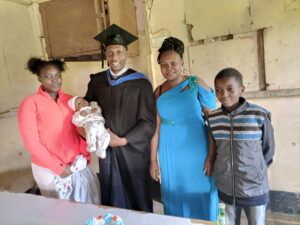
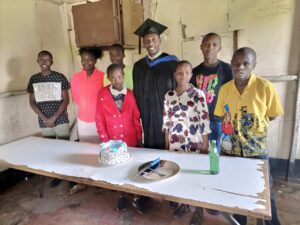
The team at Watu wa Maana include many key people. There are cooks, a gardener, a social worker and those who serve organising the finances and policies. As well as having them work serving the children, Grassroots tries to fund their development as people. James has been serving with us as the house father at Watu wa Maana and the pastor of the worshipping community that meets of a Sunday on site. While doing this he has also been attending theological college and working towards his degree, and Grassroots has helped Watu wa Maana fund his education. In the last few weeks he sent us this message and photos:

“I greet you in Jesus Name. I believe you and your family are well. My family and I are well in Christ and the Grace of our God has been sufficient. I would like to inform you that by the grace of God I graduated last Friday with a BA in Biblical Studies and Pastoral counselling. I also thank God for enabling me to graduate with First class Honours. On Sunday I shared a cake with my family and the few children at Watu wa Maana Centre.
I take this opportunity to appreciate you and your family and Grassroots family for your support towards my success. May almighty God bless you and keep you safe so that you can continue to do the ministry in Christ’s vineyard all over the world.
Once again, thank you very much. You are always in our prayers.
Pastor James N”
James and Charity have also become proud parents of a little boy called Kibali Ngotho. He was born
on 30th August. Charity, who is also the staff social worker responsible for reintegration, is currently on maternity leave. James & Charity and their children now live in their own home near the centre but also have a room on site for use when they need to stay over. Although Charity’s work is greatly missed, she is often seen at Watu wa Maana.